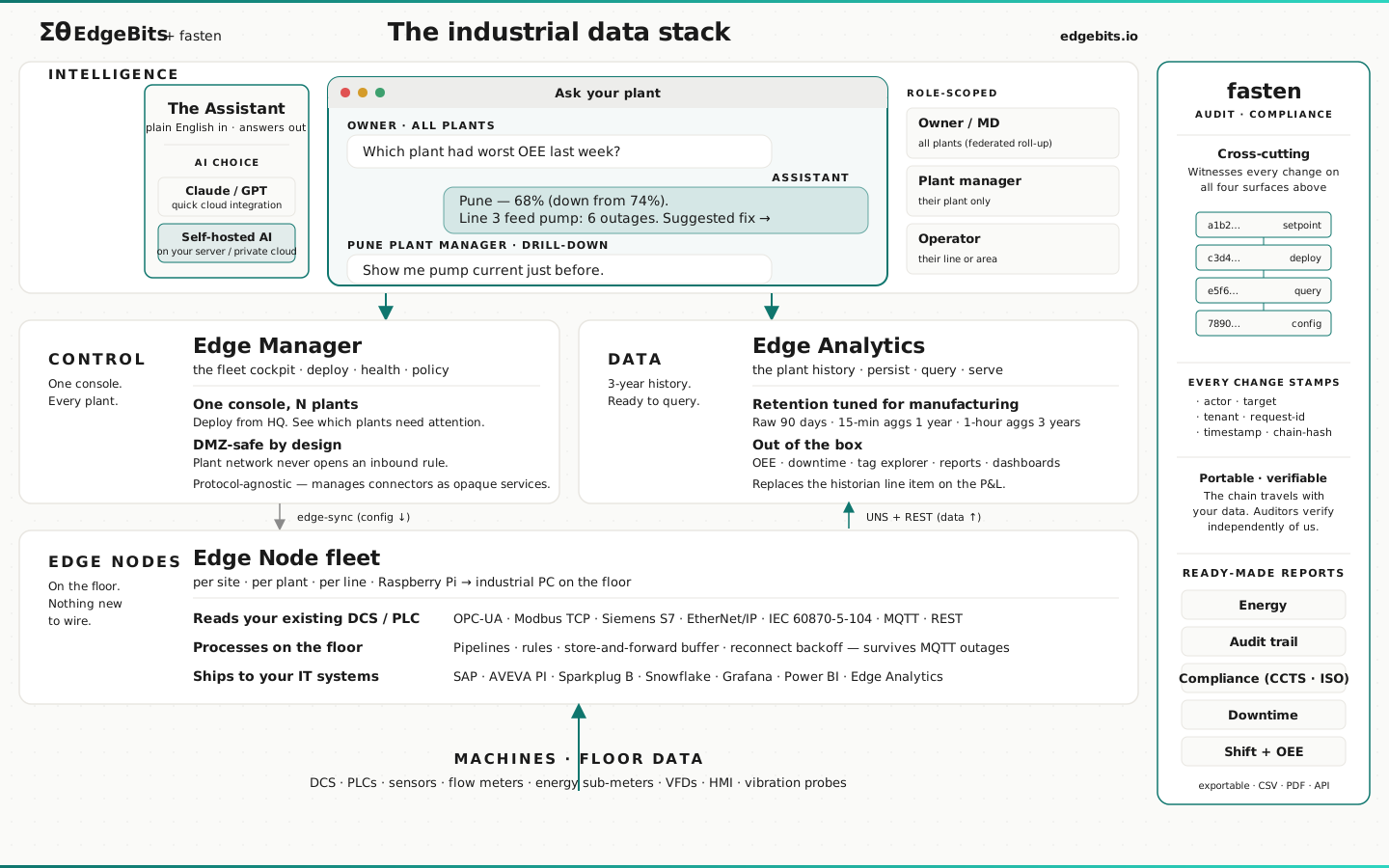
Your machines, your data, your fleet — and one place to ask about any of it. Every change witnessed by an audit trail you can export.
Stop digging through dashboards. Your team asks questions in the language they already use: "why is line 3 slower today?", "which plant had the worst OEE last week?", "show me pump current just before the outage." Answers come back with the audit trail attached.
Three capabilities that turn plant data into answers your team can act on.
Bring your DCS, PLCs, and sensors into one clear view — every plant, every line, every shift. Deploy on the plant floor, on a server you own, or on your private cloud. Standard protocols end to end: OPC-UA, Modbus, S7, MQTT.
A full line in about a week. Nothing on the plant floor changes.
Your team asks questions the way they'd ask in a shift-review meeting. The assistant reads your plant history and every change across the fleet, and answers with the reasoning trail.
Same experience whether the AI is Claude / GPT (quick integration) or self-hosted on a server you own.
Every setpoint, deploy, config edit, and question asked stamps the audit chain with who, when, and what. Auditors verify independently.
Compliance-ready reports for energy, CCTS, ISO, downtime, and OEE. Export as CSV, PDF, or straight into ERP or BI.
An assistant bolted onto raw tag history can fetch you a number. It cannot tell you what that number cost, why it moved, or whether the fix worked. Underneath this one is an Operational Intelligence layer that already did that work.
Unplanned downtime, slow running, scrap, energy drawn against baseline: every loss across the plant on one list, biggest first, in whatever currency you run on. So “which line hurt most last month” has an answer before anyone asks it.
Each line's variance from the baseline it should be holding, side by side across the site. The outlier is not an opinion in a meeting — it is the bar that sticks out, and an engineer gets the comparison instead of an afternoon in a spreadsheet.
Line 2 drew 4,400 kWh and produced 1,400 units. At its baseline it should have drawn 3,900, so 500 is excess — and some of that went while the machine was sitting idle, producing nothing at all. Same arithmetic for water in m³, or air, or kg CO₂e.
The assistant reads all of it, scoped to whoever is asking. More on the intelligence layer.
Your machines, your data, your fleet — and one place to ask about any of it. Every change witnessed by an audit trail you can export.
Owner sees every plant. Plant manager sees theirs. Operator sees their line. The system knows who's asking and only shows what they're supposed to see — enforced on the server, not just hidden in the screen.
All plants. Federated roll-up. Raw data stays at the plants.
Their plant only. Data from other plants is not returned.
Their line or area. Live values, current alarms, immediate history.
Ask for Six Big Losses breakdown, A × P × Q split by shift, Top Loss on any line, Component Log entries, reason-code accuracy — in the vocabulary your Kaizen team already uses.
See the TPM viewThe assistant connects to AI models through an open standard, so any current or future model plugs in. Change your mind later? Swap the model. Nothing else changes — and you are never locked to one AI vendor.
Quick integration. Fastest to set up.
On a server you own — plant floor, data centre, or private cloud.
30-minute call. We'll wire the assistant up to a slice of your existing data and let you ask it questions live.